
Harmful/Problematic Sexual Behaviours in Children
Curiosity and exploration are part of healthy sexual development in children and young people as they grow.
During childhood and adolescence, young people are still developing their identity, social understanding, sexual awareness, and cognitive capacity.
Sometimes, behaviours can become concerning, problematic, or harmful. This can happen for many different reasons, and often reflects something important going on for the child, rather than intent to cause harm.
It is important that children and young people who display concerning sexual behaviours are not labelled in the same way as adults who commit sexual harm, such as being called "abusers" or "perpetrators". Using these labels can create shame, stigma and emotional harm.
Instead, a trauma-informed approach emphasises curiosity and understanding, encouraging careful consideration of the child's
- developmental stage and capacity
- life experiences
- environment and relationships
- current stresses or unmet needs
Understanding what is happening for the child or young person is a key step in identifying the right support and, where needed, appropriate intervention.
When Does Sexualised Behaviour Become Concerning, Problematic or Harmful?
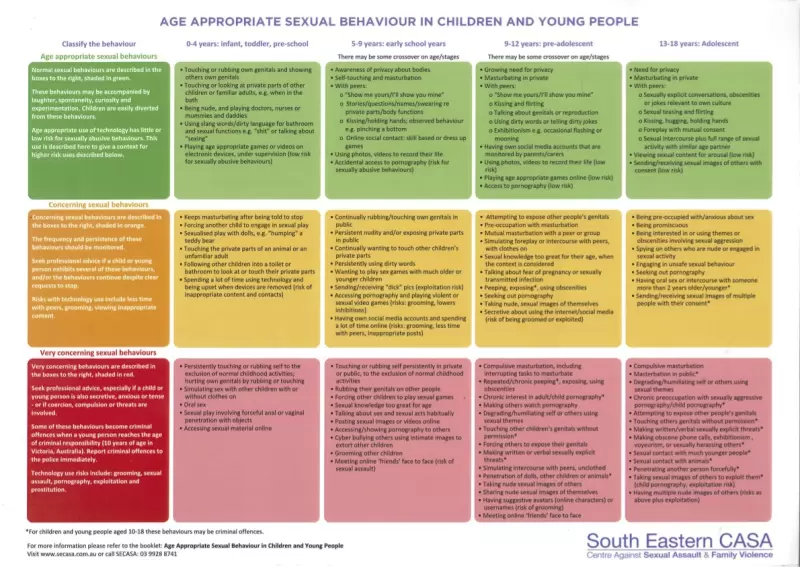
Sexualised behaviour is seen as occurring along a continuum of developmentally appropriate through to inappropriate, concerning, to problematic, through to harmful.
It can become concerning, problematic or harmful if it is:
- Excessive
- Secretive
- Compulsive
- At a frequency greater than would developmentally be expected
- Carried out in a coercive or threatening manner
- Where there is an age difference of more than two years
Understanding Age-Appropriate Sexual Behaviour
It may be helpful to review this resource from SE-CASA that provides an overview of age-appropriate sexual behaviour to help gauge where behaviour may fall along a continuum of development.
It is important to remember that while there are general developmental milestones, each child is different. All aspects of their unique situation and life experience need to be considered when understanding behaviour.
Most children who exhibit sexualised behaviour do not go on to become adult sex offenders. With education and support, they do not go on to repeat behaviours.
You can contact SACL or your local CASA to discuss any questions or concerns.
How To Respond
If a child has engaged in problematic or harmful sexualised behaviour:
SACL sometimes receives calls from parents and caregivers seeking information and support when they become aware that their child has engaged in concerning behaviour.
Children often do not understand why they behave in this way, and may experience confusion, anxiety, shame or anger regarding their behaviour. They may have experienced unsafe behaviour themselves (especially if they are very young).
What can help:
- Be calm, open, curious and non-blaming in all interactions
- Be specific when asking or talking about what behaviour is not appropriate. (ie "Can you tell me what happened?" and "It is not okay or appropriate for you to touch ...... or take their hand and touch your penis"
- Be clear with the child about stopping the specific behaviour. Avoid general statements like "don't be inappropriate or naughty". If you observe it happening, you can calmly redirect their attention or remove them from the situation
- Separate the behaviour from the child; that is, it is the behaviour that is not okay
- Reassure the child that it is safe to talk, they are not in trouble, and that you need to understand what has happened. Reassuring the child they are not in trouble does not mean there won't be consequences.
- Be clear about what will happen next, and who may need to be involved (for example, school or police), and why
- Provide education about body autonomy, privacy and sex education appropriate to their developmental age
- Keep usual routines so your child feels secure and supported
- Where appropriate, connect with a specialist service for therapeutic care or counselling, to support safe behaviours and respectful relationships.
Try NOT to:
- Deal with the situation in public (instead, talk to the child in private)
- Get angry or over-react
- Minimise or dismiss the behaviour (eg. "kids just being kids")
- Use fear or threats to eliminate the behaviour (eg, saying they will be put in prison or expelled)
- Label the child (eg, "pervert", "offender" "molester")
- Promise secrecy
- Tell the child how you feel about the behaviour (eg, that you are angry or disappointed)
If a child has experienced problematic or harmful sexualised behaviour
It is important to provide a safe, calm, and reassuring response to a child who has experienced problematic and/or harmful sexualised behaviour.
Children will have their own responses, feelings, and understandings of what has happened. Listen to them talk as they feel able, without expressing your feelings about what they are saying.
It is important not to minimise or dismiss impacts or a child's experience, because the behaviour has been enacted by another child. Sexualised behaviour from another child can have the same impact as from an adult. Having some guidelines in how to respond can support the child and you in managing what has happened.
There is no right or wrong way for a child to respond to experiences of sexual harm.
Listening, believing and reassuring them are key steps in responding.
How to respond:
- Remain calm, open and curious: Ask open questions (eg, "Can you tell me what happened when you were playing?" rather than leading questions like "Did your friend do...."). This allows space for the child to find their own way of describing what has happened
- Reassure them they are not in trouble and have done nothing wrong
- Do not promise secrecy and explain if you need to speak to someone else.
- Maintain routines to support a sense of predicability and safety
- Expect that your child may have differently to their usual self. Use reassurance, gentle boundaries and consistency
- Make a safety plan. Contact SACL to talk this through. Ensure the child is monitored/supervised if they have ongoing access to a child who has experienced the behaviour. This may include working with a school or childcare service on a safety plan.
Try NOT to:
- Minimise or dismiss the experience, including because another child was involved
- Suggest the child is too young to be impacted or remember
Access to timely specialist therapeutic support can assist both the child and their parent or caregiver. Contact SACL or your local CASA for support and discuss the option of you and/or your child seeing a Counsellor/Advocatee for support.
Support For Parents and Caregivers
It can be distressing and confusing to navigate these situations.
- Be assured that support is available
- Reaching out for information and guidance can help you support your child and your family
- Each person involved may have different feelings and responses, and this is normal.
Do we need to contact Child Protection or Police?
All adults in Victoria have a responsibility to help keep children and young people safe.
There are legal safeguards in place to protect children and young people under 16 years of age. There may be times when it is necessary to contact Child Protection and/or Police to discuss concerns about risk or harm.
At SACL, we have a duty of care to respond to situations of immediate risk. This may include contacting specialist services such as the Sexual Offences and Child Abuse Investigation Team (SOCIT) or Child Protection After Hours. You can read more here about your obligations under the Betrayal of Trust legislation.
Our approach is to:
- Be transparent
- Discuss concerns with you; and
- Work with you to plan next steps and bring in additional supports where needed.
We encourage people to reach out to Child Protection and/or SOCIT if they are unsure whether a report is required.
If you are a young person, you can access information here about what happens when Police are involved and what your options are.